|
Vol. 114, No. 11
|
March 14, 2007
|
SkyWarn spotter class
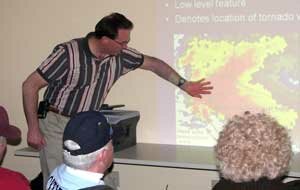 Photo by Vickey Carwile Photo by Vickey Carwile
Joe Sullivan with the National Weather Service, explains to SkyWarn spotter class participants the signs of a hook echo during severe weather.
By VICKEY CARWILE
Messenger Staff
Approximately 35 people gathered March 8 in the training room at the Meade County Health Department in Brandenburg for a storm spotter training course presented by Joe Sullivan, warning coordinator for the National Weather Service in Louisville.
Those attending were members of Meade County, Ekron and Battletown fire departments, several HAM operators from Meade County and Harrison County, Ind., some local law enforcement personnel, members of Battletown Neighborhood Watch, WMMG and private citizens.
Sullivan explained the role storm spotters play and the reason the NWS needs spotter reports during severe weather.
• Helps the NWS decide whether to issue warnings;
• Provides specific information to people in the path of storms which helps save lives;
• Provides ground truth information; and
• Creates a local climatology data base.
Many types of weather information are needed for storm spotters. Some of the reporting criteria should receive higher priority communication than others. Spotters should report the following weather events:
Urgent priority
• Tornado
• Funnel cloud
• Rotating wall cloud
• Flash flooding
High priority
• Hail 3/4-inch in diameter or larger
• Wind speed greater than 58 mph
• Persistent nonrotating wall cloud
• Rainfall 1 inch or more per hour
Lower priority
• Hail 1/2-inch diameter or larger
• Wind speed greater than 40 mph
• Cloud features suggesting storm organization
Other locally-defined criteria
such as downed trees or power lines, snowfall, icy roads, sleet or freezing rain.
When reporting severe weather, spotters should inform the NWS who is reporting the weather condition, what type of severe weather is occurring, when the severe weather began and where the spotter is located.
For more information about becoming a storm spotter, go to http://espotter.weather.gov or e-mail cr.espotter@noaa.gov.
For information on preparing for severe weather, go to www.weather.gov.
Click Here to Go Back

Copyright © The Meade County Messenger.All rights reserved.
Award Winning Member of the Kentucky Press Association
|
