
|
|
| Vol. 114, No. 38 |
September 19, 2007
|
Brandenburg tankfuls . . .
Frankfort’s Old State Capitol provides charm, intrigue and mystery
 Photos by Larry See Jr.
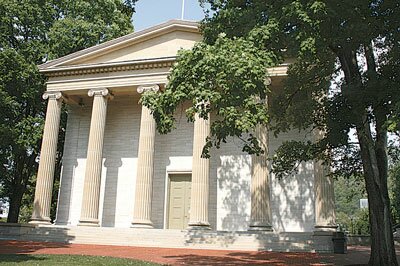
A sense of awe and majesty overcomes one as they approach the entrance to the Old State Capitol in downtown Frankfort. Tours are offered Tuesday through Saturday as part of the admission for the Thomas D. Clark Center for Kentucky History. Several rooms feature period furnishings while others include reproductions, thanks to the meticulous records kept during the period.
By LARRY SEE JR.
Messenger Staff
NOTE: This is an occasional column featuring “tankful” travels. All locations are within a 60-mile radius of Brandenburg and can be accessed with one tank of gas or less. Readers are urged to check the Web sites for current hours and events as they many change prior to publication.
It survived several fires, cost $85,000 to construct and boasted some of the greatest architectural feats in the West.
“It” is the Old State Capitol, located in downtown Frankfort and accessible to the public as part of the Kentucky Historical Society’s collection of museums.
One would think that after having lost the previous three state capitols to fire (they were of wood construction), local residents would start designing a sturdier structure.
The state legislature did, in 1827, when they sponsored a design contest for the building. Winning the honors was a 25-year-old Lexington architect, Gideon Shyrock, whose design was based on the Greek Revival style.
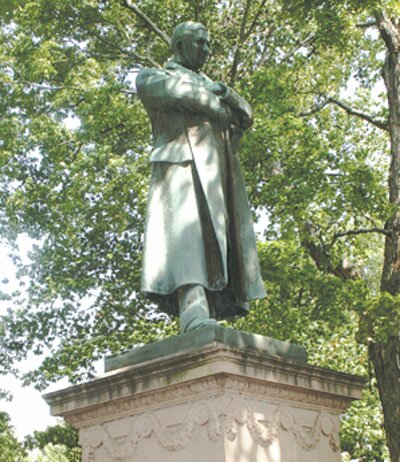 William Goebel’s claim to fame was the fact he was the only governor to be shot by an assassin. To this day, the true story of his death is still the cause of much speculation.
When one approaches the capitol from Broadway Street, there are no windows. The reason, according to the knowledgeable tour guide I received, was the fact Greek temples didn’t have windows. They instead had grand columns and a massive front porch. Shyrock did place windows on the sides, so one didn’t feel like they were entering a shoebox fit for a giant.
The interior also features a classical design, with a central rotunda topped by a domed cupola.
Not only does the dome look “presidential,” it served a dual purpose. It provided the main source of light for the Senate and House chambers, located on the second floor. The secondary source was chandeliers in each chamber, which, according to the tour guide, reportedly put out more smoke and fumes than they did light. (The building didn’t have electricity.)
Light was aided by the white stone in the structure, used primarily for the floors and stairways.
Another of the unique aspects is the self-supporting circular staircase with its weight dependent upon a single keystone. If the arched stairs were moved 1/10 of an inch, the entire stairwell would collapse. The design is the only one in existence in the world.
Not all was quiet during the tenure of this building.
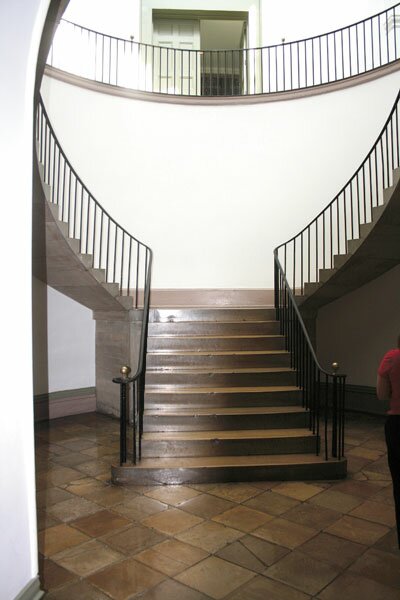
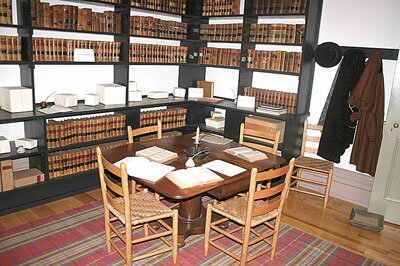
Left, this circular staircase leads to the Senate and House of Representative chambers on the second floor. The staircase is self-supporting and is considered an engineering marvel, due to its unique construction. Right, the law library looks like visitors left it for a minute. Several of the pieces are original items, including several books lining the shelves, which in some cases stretch from the floor to the ceiling.
During the Civil War, Kentucky was a border state, deciding not to support either the North or the South.
As such, this was the only pro-Union state capitol occupied by the Confederate army. Plans to swear in a Confederate governor and establish a state government were dashed the 1862 Battle of Perryville, allowing the Union to maintain a foothold in the state.
Soon to arrive was Democratic gubernatorial candidate William Goebel.
His arrival was short-lived though, following the contested election, he wanted to hear what the decision of the state legislature would be. (At the time, due to a lack of space, the governor’s office was down the street.)
Upon his arrival, what is believed to be a pro-Union sympathizer (and this is how the story goes) stuck a gun out the window of what is believed to be the Secretary of state’s office and shot Goebel as he approached the capitol. Neither the assassin or weapon were recovered.
The Democratic-controlled legislature named the lieutenant governor the acting governor, and he managed to carry out many of Goebel’s wishes during his tenure.
In the interim, armed citizens and state guard soldiers occupied the capitol grounds, ensuring no further acts of violence would occur.
The state law library features period chairs, tables, ladders and a desk and is the first library of its type west of the Allegheny Mountains. The library and building also house portraits of notable figures, several of whom visited the capitol.
The third capitol, adjacent to the old capitol, was occupied in 1830, after a construction cost of $85,000. The building is still standing, but is now used for governmental offices. The architecture is Greek Revival.
The fourth, and current capitol, was completed in 1910. Designed in a Neoclassic Revival form, it cost $1,750,000 and is still in use today.
Getting there:
From Brandenburg, take KY 1638 to U.S. 31W. Go north on U.S. 31W toward Louisville. Near Louisville take the Gene Snyder Freeway east until it intersects with I-65.
Follow I-65 east about 35 to 40 miles until you reach Frankfort. From the freeway, directional signs will lead you right to the capitol and other city historic sights.
To visit the old capitol, one must purchase a one-price admission ticket at the Thomas D. Clark Center for Kentucky History Center, located about a block east. Tours leave from here every hour on the hour, and guides are very knowledgeable.
Call: (502) 564-1792.
Web site: www.history.ky.gov

Copyright © The Meade County Messenger.All rights reserved.
Award Winning Member of the Kentucky Press Association