
|
|
| Vol. 114, No. 47 |
November 21, 2007
|
Payneville farmers bow to pressure; cancel poultry plans
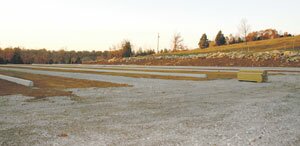 Photo by Larry See Jr.
The three long strips were once going to be poultry houses, operated by the Mike Greenwell family. They now sit empty, with the frames and other wood expected to be hauled off the property Monday to another job site. The family has no plans as of this time for their property, which once was a productive alfalfa field.
By LARRY SEE JR.
Messenger Staff
Mike and Tambra Greenwell wanted to complete their poultry operation on a first-class basis, even looking into a specially-designed German air filtration system to prevent any noxious odors from seeping into the neighborhood.
They poured extra money into construction, opting to remove large boulders in order to keep the operation out of the public eye.
They paid for a well-maintained gravel road, leading from the house to the operation, located at least 5/10ths of a mile away – and situated between two woods.
And all rules and regulations placed onto them by state and county officials were obeyed.
But Friday, Nov. 16 at about 2 p.m. the Greenwell family threw in the towel, acquiescing to pressure put on them by facility opponents, who enlisted the aid of Sierra Club Midwest associate representative Aloma Dew, and cancelled their dreams – forever.
“Tyson has been in our corner 110 percent,” Mike Greenwell said, adding he could say nothing bad about the Corydon staff assisting him with the proposed operation.
“David Whittington and Ken Bartley have been in our corner the whole time and they have actually bent over backwards for us,” he continued. “I have nothing bad to say about Tyson.”
Mike, if he could, would still like to find a way to operate a poultry farm, working with the Arkansas-based operation, raising chickens and returning them to the company.
Tyson officials worked closely with the family, walking the ground and suggesting areas where the poultry operation could be placed. Some ideas were used, Mike said, while others such as the location, weren’t, but that was only done so in order to maintain good relations with the neighbors.
“We feel our rights have been violated,” Mike said. “But again Tyson has been in our corner 110 percent. I just can’t say enough good about them.”
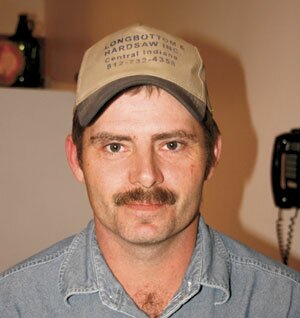 “We have a lot of nice reports.
We just can’t grow any birds.”
– Mike Greenwell
Mike has inquired about a potential lawsuit, discussing the idea with law firms. If one is located, he hopes it would be taken on a pro bono basis. Mental anguish and a violation of the family’s rights are at the top of the list.
The Greenwells, had their operation succeeded, would be the eighth grower working with Tyson locally, according to Mike. Because of the intense media scrutiny, both a map showing the other farm locations and information regarding the family’s manure management plan, filed with county Natural Resources and Conservation Service officials, have been sealed. The sealing occurred, in part, because opponent Kathy Carden had requested to see the personal information without the Greenwell’s permission.
Contrary to earlier statements, the Greenwell’s didn’t sign a contract regarding the operation. They did show a letter of intent, signed by Bartley, stating the procedures for which they would operate the farm, the size of the buildings and other particulars, but Mike said they were under no obligation to sign it. The document was signed by Bartley and there were no signature lines for the Greenwell’s, nor did they sign.
“There was no contract,” Mike said. “We did not sign a thing for Tyson.”
The operation, which now resembles three county fair mud bog tracks, resided on what was an alfalfa field. Now, with the construction crews removing the topsoil and contractors laying cement for the foundations, the land is unusable.
Under the letter of intent, the Greenwell’s were to construct three 43x500 buildings. The chickens would be delivered and picked up and a team would regularly inspect the operation to ensure all company’s procedures were followed.
Mike said the family started looking at their options in January, thinking adding the poultry operation would be good for the family’s already-present beef and tobacco crops.
“It has taken us all year just about when we approached Tyson,” Mike said, adding they originally were considering a rival firm, based in Jasper, Ind., but settled on Tyson in part due to travel issues.
“We looked at the firms, went to the NRCS office and everything was working out great,” Mike said. “We wanted everything to be neighbor-friendly.”
One afternoon, Mike returned from his full-time job at the Kosmosdale Cement Company to find a lady from an area historical society in his driveway.
He recalled she asked about the proposed operation. He said, while she couldn’t drive down to the site as the road had yet to be constructed, she could walk down to see it.
“She said she didn’t have her walking shoes on so I invited her to come back the next day,” Mike said. “I also told her there was nothing down there (of any historical value) and if there was anything (there) that we had row cropped it for the last three or four years and had not even found any flint or anything.”
Despite that, the family found themselves having to foot the costs for an archaelogical survey, conducted by the University of Kentucky.
“UK sent two archaelogists down here during the summer and they dug 30-plus holes,” Mike said. “And it was really hard ground, as you know we didn’t have a lot of rain during the summer. They found nothing, but we still had to wait for their report.”
“We also had to do a title search and wait for the results to come back on that,” Mike said, adding it seemed like one roadblock after another was placed in front of them.
“We actually started construction, and I mean the dirt work, sometime in July or August,” Mike said. He thought construction would be finished in October, but Tyson officials were indicating it would be either November or December.
And the result?
“We have a lot of nice reports,” Mike said. “We just can’t grow any birds.”
Neighboring residents were advised of plans, Mike said, adding those he discussed the operation with supported it. One neighbor, the owner of a nearby day care center, signed a waiver not objecting to the operation and another asked for a part-time job when it became operational.
“We just want to let people know there is absolutely no truth to the things they are saying about Tyson,” Tambra said. “If Kenny was lying to us, why was he making arrangements for us to visit other poultry producers in Indiana?”
Mike thought it wasn’t right one or two people could come in and tell others what they could or couldn’t do.
“They (the opposition group) could do this (shut down) all poultry operations and then start on the cattle operations and everybody else,” he said. “I wish we had more support from the school board.”
School officials wrote letters to the Greenwell’s and Tyson strongly suggesting the operation be relocated, or threatening legal action. That was one aspect which Mike suspected resulted in the firm’s decision not to continue.
His children, Shane and Brittany, both students at Meade County High School, are active FFA members and learn farm safety daily while operating equipment.
‘I teach farm safety all the time,” Mike said, adding he feels comfortable when Shane operates a tractor and rationalizes to solve a problem in the field when it occurs. The duo also show steers and hogs at the county fair and Shane is a committee chairman for the local FFA chapter.
In addition to Tyson officials, Mike said county magistrate Randall Hardesty has been supportive throughout their ordeal and county Planning and Zoning commission vice chairman Alan Flaherty visited.
“He checked it out to make sure everything was okay and told us that he didn’t have a problem with it,” Mike said, adding it conformed with all county zoning requirements.
“Words cannot describe how well Tyson treated us,” Mike said. “Every time I called Tyson they asked me what the question was and they said they would either get me the answer right then, or if not they would call me back later that day. They always called me back, whether it was later that day or in the evening.”
“You could not ask for a better group of people,” he said. From the commentary they read in the local media about the community rallying around them after their business was shut down, Mike had this comment.
“From the way I was taught, that (working to close their business) is not any support,” he said.

Copyright © The Meade County Messenger.All rights reserved.
Award Winning Member of the Kentucky Press Association