
|
|
| Vol. 115, No. 25 |
June 18, 2008
|
Don’t kill those beneficial bees Call the ‘bee busters’
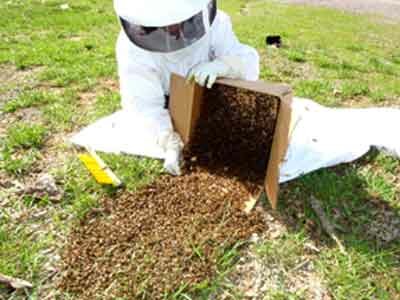 Photo courtesy of Amy Serafin
Amy Serafin collected this swarm which was found on the ground at Abe’s Country Store. It’s the first swarm any local beekeepers have found on the ground.
By SANDRA STONE
Messenger Staff
You’re working in the yard and hear the distinct buzzing of honey bees. You look up and see a beehive in a tree. What do you do?
According to Andy Mills, Meade County Agriculture Extension agent, you shouldn’t destroy the hive or call an exterminator. Rather, call a beekeeper. Mills has a list of local beekeepers who will be happy to take the bees off your hands and add the bees to their own hives or give them to someone who will be able to use them.
“I try to get every swarm I can and keep them from getting killed,” said local beekeeper Wayne Roberts.
The collection process is pretty simple, according to Roberts. “I have a 5-gallon cooler. I shake the swarm off in the cooler, take them home and hive them up,” he said. Some people, he said, take the hives out to the property and leave them for a few days, but Roberts said, “I’d just rather bring them home with me when I get them.”
Roberts recently collected a swarm of bees in a woodstove chimney at Ernie and Susie Embry’s residence. He and Marty Cain, who often assists him, built a small fire to smoke the bees out. They then swept the bees off the side of the chimney and into a garbage can.
Beth Greer, a third-generation beekeeper, has about 10 hives, and she uses her bees to pollinate crops, but also “for all that good honey.”
A hive is as good as its queen, said Greer. “One hive has 100,000 bees in it and they’re all working. There’s order to the chaos because she’s an amazing queen.”
Greer has caught nine swarms this spring. She has kept two to build up her own hives and then given the rest away to other beekeepers just getting started. Beekeepers are a generous lot, said Greer, helping each other whenever they can, sharing bees and information.
 Photo courtesy of Melissa Embry McRae
This swarm was found in the chimney of a woodstove at the home of Ernie and Susie Embry. Collecting the bees are Wayne Roberts and Marty Cain.
Jerry Greenwell, who kept bees and sold honey for many years, was instrumental in helping Greer get back into beekeeping. “He is very generous in his knowledge,” she said. And now Greer shares that knowledge with others, sharing with school classrooms and helping new beekeepers such as Amy Serafin get started.
Serafin took two swarms in May within days of each other. The first was a hive found in a honeysuckle bush by Doris and Russell Farrow. The other was a swarm from the property at Abe’s Country Store. “It was the first swarm any of the local beekeepers have ever found on the ground,” said Serafin.
“Bees are pollinators,” said Mills. “A great percentage of our crops must be pollinated by something, and honey bees are the most common insect to go after pollen. That’s why they’re so beneficial.”
Mills said research has shown fields with beehives placed around them have experienced larger yields than those without beehives nearby. Roberts said he places beehives around the Roberts family farm, and the bees pollinate the blackberries and pumpkins for which the farm has become well-known.
The bees are doing their jobs, but bee mites and pesticides have taken a toll on their numbers.
Before the mite infestation got so bad in the 1980s, Greer said her grandfather had 120 hives in Barren County. He lost about half his hives.
“People have been treating them since then,” said Greer, “but the treatment has only built a bigger and better mite. They realized the chemicals were not good, so they switched to a more natural mite treatment.”
Roberts has had his own challenges with mites and the decline of the bee population. He started out 25 years ago with about 25 hives, but mites took their toll, and then he lost four this past winter. “There are so much chemicals anymore,” said Roberts. “I think that’s a lot to do with it.”
The best advice Mills can give people who wish to preserve the bee population is to be careful about the application of insecticides. The best time, he said, is late in the evening after the bees have returned to their hives for the night. This way, he said, the application does not affect them, and the insecticide has dissipated before the bees return with the light of day.
For more information about honey bees, hives, swarms and anything to do with apiculture, contact the Meade County Extension office at 422-4958.

Copyright © The Meade County Messenger.All rights reserved.
Award Winning Member of the Kentucky Press Association