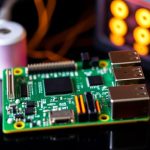
In today’s fast-paced digital age, the evolution of technology is relentless, with new advancements making headlines almost daily. One such technological arena that has consistently been at the forefront of innovation is the field of microprocessors. These tiny yet powerful devices are the heart of virtually all modern electronics, from the smallest gadgets to the largest data centers. Let’s delve into the fascinating world of microprocessors, exploring their history, how they function, and their profound impact on technology and society.
Work revolution: Google reveals 90% of professionals are already using AI daily – are you one of them?
Gigantic 400-meter structures discovered beneath Antarctic ice spark heated debate among scientists worldwide
## The Heart of Modern Technology: Microprocessors Explained
At its core, a microprocessor is a miniature electronic device that can perform the functions of a central processing unit (CPU) on a single integrated circuit (IC). Composed of millions of microscopic components like transistors, capacitors, and resistors, microprocessors execute a series of instructions from a computer’s memory to perform tasks and processes. This capability makes them indispensable in systems where computational tasks are essential.
The advent of the microprocessor in the early 1970s revolutionized the tech industry. The first commercially available microprocessor, the Intel 4004, debuted in 1971. This chip, designed for calculators, was a precursor to the powerful processors that would soon drive the entire computer industry. Today, microprocessors are more sophisticated than ever, capable of processing complex software applications and supporting the infrastructure of the digital world.
## A Timeline of Innovation
The journey of microprocessor development is marked by significant milestones that have spurred technological advances and shaped the computing landscape. Following the Intel 4004, the 1970s and 1980s saw rapid advancements in chip technology, with each new generation bringing more power, efficiency, and complexity. For instance, the introduction of the 8-bit processors, followed by 16-bit and 32-bit versions, allowed for increasingly complex computations and functionalities.
The 1990s ushered in a new era with the development of the Pentium processor by Intel, which significantly enhanced the multimedia capabilities of computers. This period also saw the rise of mobile computing, with microprocessors becoming small and efficient enough to power the first portable devices.
In the 21st century, the focus shifted towards multi-core processor designs, which contain two or more separate cores (or CPUs) in a single microprocessor unit. This design enables more efficient processing of multiple tasks simultaneously, a crucial feature in today’s era of multi-tasking electronic devices.
## Enabling a Connected World
A YouTuber bought a Bugatti on TEMU expecting luxury… but the unboxing went terribly wrong
Colonizing Mars is no longer a dream: Elon Musk unveils a historic deadline that will change everything
The impact of microprocessors extends beyond the obvious realms of computers and smartphones. They are pivotal in the operation of a myriad of devices and systems, including household appliances, medical instruments, automotive controls, and even critical infrastructure like telecommunications networks and energy grids.
Moreover, microprocessors play a critical role in the development of emerging technologies such as the Internet of Things (IoT), artificial intelligence (AI), and robotics. By providing the processing power needed to analyze large datasets and perform complex algorithms, microprocessors are at the heart of innovation in these fields, pushing the boundaries of what’s possible.
As we look to the future, the evolution of microprocessor technology continues to be a key driver in the tech industry. With advancements such as increased integration density known as Moore’s Law, and innovations in nanotechnology and quantum computing, microprocessors are set to become even more powerful and integral to our daily lives. The journey of the microprocessor is far from over, and its trajectory promises even more exciting developments in the years to come.
Similar Posts
- Revolutionize Your Listening Experience: Upgrade Now with ElevenLabs AI Narration!
- AI Narration Revolution: Upgrade Your Listening Experience in Just 5 Minutes!
- Unlock the Future of Listening: Experience AI-Powered Audio with ElevenLabs’ Upgrade!
- Revolutionize Your Listening Experience: Discover AI-Powered Audio with ElevenLabs!
- Unlock the Future of Audio Books: Experience AI-Powered Narration by ElevenLabs!

Byron Tiller is a journalist deeply rooted in America’s social and political landscape. He provides insightful analysis of events shaping the United States, from federal decisions to local challenges. With sharp curiosity and critical thinking, he helps readers grasp the evolution of American society.