Meade County Messenger hosts debate; candidates make their cases
By JOE REDMON Messenger publisher Rena Singleton hosted a political candidate debate Oct 25, at the Farm Bureau building in Brandenburg. Due to time constraints, only the state representative and judge executive races were invited to participate. The debate’s panelists were drawn from diverse segments of Meade County. Karen Kennedy (Messenger) and Dave Clark (WMMG) represented the media, Russ Powell (Chamber of Commerce) represented the business community, Earl Fitzgerald (Republican) and Ed Hardesty (Democrat) represented the local political parties. The debate format called for 15 questions of each race, with candidates rotating who received the question first. When asked a question by the panelist, Candidate A had 60 seconds to respond. Then, Candidate B had 90 seconds to respond and rebut, followed by Candidate A having 30 seconds for a final rebuttal. The process then repeated throughout the evening. At the end of the evening, all four candidates had time for a closing statement. The first candidates to answer questions from the panel are running for State Representative of the 27th District, which includes all of Meade County, West Point, and four precincts in Bullitt County. The candidates are Rep. Gerry Lynn (R-27th) running for reelection and Jeff “Frog” Greer (D). Questions asked ranged from basic “What are your qualifications for office?” to “What are your views on same-sex marriage?” to “How do we keep and attract good-paying jobs?” There was more agreement than disagreement between Rep. Lynn and Greer during most of the debate. The differences between the two candidates included answers involving state government’s involvement dictating required acreage for horse ownership and cigarette taxes. A question from Kennedy asked their opinion on why the Kentucky Revised Statutes (KRS) doesn’t specifically address the acreage requirements for horse ownership in this state. Rep. Lynn called it a “local issue” and wondered whether a comprehensive law could be written in Frankfort covering “each of 120 counties in Kentucky.” Mr. Greer was more open to the idea of the state government attempting to solve this problem. Their comparative answers illustrated competing visions of government. Another question from Kennedy, regarding the level of gasoline and cigarette taxes in the state, elicited very different answers from the candidates. Greer stated he was against a gasoline tax increase, but was open to increasing cigarette taxes. Rep. Lynn, while pointing out that gasoline taxes fund our state’s road projects, stated he opposed such tax increases. The race for county Judge executive is between Harry Craycroft (D), a retired teacher currently employed in the Property Valuation Office, and 4th District Magistrate Theresa Padgett (R), a local business woman. Panelist questions were similarly wide-ranging as in the other race and ranged from “What do you see as the most critical issue facing the county?” to “How would you restore ‘order’ to Fiscal Court?” to “Give us details of your educational background.” The answers to these and many other questions established a trend: Magistrate Padgett’s answers tended to cite more details while Craycroft’s answers were more apt to look at the bigger picture. When asked about the “biggest issue facing the county,” Padgett answered “jobs” and Craycroft responded “division.” When queried “Where do you see the county in four years?” Padgett responded, “More jobs and paved roads,” while Craycroft answered “draw factions together” and “a comprehensive plan.” For Padgett, “more jobs” is directly related to “less taxes.” Regarding taxation, generally, Craycroft cited figures which ranked Meade County 41st in overall taxation, out of 120 counties. While Padgett pointed out that U.S. Census figures show about two of three residents of Meade County work outside the county and this should be “fixed” through a more comprehensive approach to jobs creation in the county – Craycroft countered that according to the same Census data, persons in Kentucky average 31 minutes of driving to their jobs, while Meade County people average 38 minutes of driving to their jobs. In a crowd-pleasing moment, Craycroft noted “it was worth the seven minutes to live in Meade County!” Each of the four candidates thanked the Messenger for hosting the event. About 250 of the public were in attendance to hear these candidates discuss and debate relevant local issues of importance. Nov. 7 is Election Day; make your voice heard. DEBATE 2006 – House of Representatives Panelists: Earl Fitzgerald, representing the Republican Party; Russell Powell, Meade County Area Chamber of Commerce; Karen Kennedy, local columnist; David Clark, local radio personality; and Ed Hardesty, representing the Democratic Party. Elizabeth Kingsland, Extension agent for Family and Consumer Sciences, Hardin County, served as moderator of the debate. Explained the process and rules of the debate. Rev. Willard Knipp and Barbara Harned reviewed the questions for redundancy. Knipp kept time during responses. State Representative, 27th District ED HARDESTY: In the past few years, Kentucky has lost over 48,000 good-paying manufacturing jobs. As a state representative, what programs would you support or initiate to return manufacturing jobs to Kentucky and increase employment in our local area? GREER: I think the first thing I would look to do is provide some tax incentives to be able to keep those companies and jobs right here in Kentucky. I would work to lower health care costs. I think a lot of the companies that are relocating or moving away are doing so because of the rising cost of health care. It makes it better for them to go elsewhere than to stay here. I think that I would work to fully fund education and work more toward technological education, vocational education if you will, a better task force to create better employees. The more valuable the asset of the employees, the more valuable the asset of the company. For those reasons I will utilize and try to keep that company here. LYNN: If you bring more jobs back to Kentucky, we have to first make sure that we keep our jobs here. The workforce that we have here in Kentucky is excelled only by any other state for sure. We have good solid unions, we have good solid job support. And from the Kentucky side to lure more jobs here, it’s an economic development feature of the state of Kentucky to be able to bring new industry in. Some of the things that need to be expected is economic development in certain locations where there has not been an economic development push in those particular areas. Here in Meade County, we have started economic development and it needs to be pushed further. Where these outside agencies are brought in and shown what we have to offer. We have excellent job resources from personnel. We have a community group to pull from. We have an infrastructure and tax base that definitely makes these industries want to locate here. We’re in the top 10 of places in the state of Kentucky right now that they’re bringing prospective businesses here to look at relocating. GREER: I think we must always look for ways to improve, and a better workforce is the way to improve. And better health care system is the key to being able to keep our companies here. If we don’t start doing that in Kentucky, we’re going to continue to lose more and more good industries and good jobs. So that’s where I would start and I think that would help our state tremendously. DAVID CLARK: What qualifications do you possess that make you the best candidate for the job? LYNN: My qualifications started many years ago when I left high school with a high school diploma, went to college for two years, joined the military during the Vietnam era. I didn’t finish my degree, don’t have one hanging in my office, but I do have an honorable discharge. The 30 years of business experience that I’ve had with several businesses that I’ve started, some that I continue to operate today, these have given me the leadership qualities and skills that I feel are very effective to be able to represent the people and represent their voice in Frankfort to excel these type of issues that are vital to our community as a whole. GREER: My qualifications I think first start with my upbringing right here in Meade County. Being a part of this community for 42 years has given me the ability to understand the needs and values of people in this area. Number 2 is my education. I received a bachelor’s degree in business administration from Eastern Kentucky University. It’s something that has served me well in running my own business which I started from scratch with customer number one, and I’ve been in business now for 17 years. Third, I think my experience on the school board – for the last 13 years, I have been a school board member. Over 60 percent of the state’s budget deals with education. I think that I would be a very valuable asset in the legislature with my education experience, knowing what the needs are in these communities and being able to bring them back. Finally, I think being a family man right now, having two children, it makes me very hungry to see better for them. My son’s 14; my daughter’s 10. I want there to be opportunity for them. I want things to be improved, both in education and opportunity, for this area, and I think those qualities make me the better candidate. LYNN: My initial experience as far as such a varied background, coming from a military experience, starting my own construction business in Louisville, taking a failing business here in our local community and building it to where it is today. We started a daycare here also, these are the qualities I find useful – being able to interact with other legislators that are in the Frankfort General Assembly and together with these roots that I have . . . (time) KAREN KENNEDY: Kentucky’s state logo is “Unbridled Spirit” and a horse is used in the artwork of this trademarked logo. In my opinion, Kentucky Revised Statutes barely addresses the appropriate acreage for ownership of horses, merely suggesting five acres for any type of livestock and nowhere stipulating what should be the maximum number of horses per acreage. The result of this oversight is quite often abused, neglected, and starved horses. By example, at any given time, Meade County almost always has a horse abuse case in process in its court system. For a state that capitalizes and prides itself on its horses, what do you have to say about this situation and what do you think can be done to prevent horse abuse and neglect? GREER: Karen, that saddens me to hear that. I am a guy that loves horses and loves our heritage here in Kentucky and being noted for being a horse state, and if that is the case, I think that’s very poor and that disappoints me. I will support any legislation to try to correct that on the statewide level. I think they’re a beautiful animal, and for us to mistreat them like that is very disappointing. LYNN: Horses definitely are the vision that a lot of people realize Kentucky stands for. It’s a very important image that Kentucky portrays to people all around the world with several other communities???. Horses on a certain amount of area restricted by that is primarily a local issue that should be addressed at the local level with zoning and variances thereof regulating those particular type of pets, farms and that type of thing. At the state level, it’s somewhat difficult for me to put those type of restrictions. When you initiate a bill at the state level, it has to have the ability to be utilized in all 120 counties in the state of Kentucky, so what’s good for Jefferson County may not be good for Fayette County, it may not be good for Brandenburg, Meade County area, and other areas in the state. So a lot of times you have to take into consideration with those type of bills to make sure that it’s effective but yet allows the local leadership that had been elected to be able to manuver within particular ranges and parameters. GREER: Karen, I think wherever you go in these United States or elsewhere, when you mention Kentucky, they think of horses. That’s who we are, and I think it’s very important that we protect them. It’s hard to depend on the local level to do that. I think on the state level, it would be more enforceable. RUSSELL POWELL: It’s expected that gaming will be one of the hot topics during next year’s legislative session. There is general agreement that expanding gaming would require amendment of the state constitution. Would you support putting a constitutional amendment on the ballot? If so, what kind of gaming do you think it should include? If not, why do you oppose giving the public an opportunity to vote on this issue? LYNN: That was a hot topic last session, too. It never did actually get out of committee. It was discussed one end to the other. Expanded gaming – there’s so many different variations of what it will entail and to which direction it will take, that it’s according to which particular bill you want to get in as far as getting into the meat of that particular bill. Expanded gambling should be put in front of the people for a vote, and I would be in favor of that. I’ve had overwhelming correspondence for that particular issue. I don’t think that it will affect the Meade County area as much as it does several other areas of the state, and that’s what makes me realize again, my first job and duty is to the people and the citizens of this 27th District, but also I represent a portion of the state. It has to be effective throughout the whole state. GREER: This is an issue that I have put a lot of thought into, not only thinking about what it could do, but thinking about it morally. I’ve talked with my pastor about this. I’ve talked with close friends about this. I think anywhere you go you will find that you will get different opinions. Do I think we need the revenue from that? Yes. I think that we could use it in some very good places right now, education being the first thought in my mind. And if so, we would need to direct it only to go in that area, and not go toward the general fund. However, as far as approving it, I would have to agree with my opponent. I think it is something you would want to put on the ballot, let the people of our district decide that, and I think we could all live with whatever that decision may be. LYNN: Trying to utilize the revenue that comes from gaming is not a way to either begin to try to balance a budget or try to fund a particular portion of the budget. That’s already set a precedence years ago when the lottery was our ticket to funding our education, funding other budget shortfalls. As we can see several years down the road today, we’re not there. It hasn’t been as effective as they said it was, so those are issues that we’ve already learned from the past. EARL FITZGERALD: Do you think that marriage should only be between a man and a woman or do you think the definition of marriage should be expanded to include same sex marriages? GREER: I firmly believe that marriage is a union between a man and a woman. Any otherwise is not what my parents taught me to believe growing up, and it’s not what I believe right now. I think that’s how God made us here to be put on this earth, and that is my opinion in that area, and I’m pretty solid in that opinion. LYNN: I must agree with Mr. Greer. I think that is the sanctity of the family, and I think that’s probably a lot of the reasons we have a lot of problems today, starting with education and juvenile delinquency and so on and so forth, it’s the breakup of the family unit that basically is a marriage between a man and a woman and a family. I think this is very important to our existence today, also for the future tomorrow, and it should be upheld at all costs and pushed forward for the future of our kids and grandkids. GREER: This is something that I don’t know a lot about nationwide. I know about right here in Meade County, and I think I pretty well know how it stands in Kentucky. Would I listen? Yes. Do I think I would be swayed? No. I believe a marriage is between a woman and a man. EARL FITZGERALD: What would be your position on parental rights as it pertains to a minor child? Do you feel that parents should be consulted for consent in all matters that a minor child will be faced with outside the home? LYNN: That’s a good question, and there are several parameters to that question that could be answered on those different sides according to what particular issue you’re trying to go after. I feel like there are a lot of solid family values that need to be taught and basically strengthened through parental rights in the home. There are so many of these rights that have been given up today simply by educational systems and what they do in the schools. A lot of these things need to be strengthened. I think the backbone of the family unit and these particular rights are with the family. GREER: As a parent, I think it’s not only my responsibility but I think it should be expected of every parent to want to guide their child through whatever those experiences may be that you’re leaning toward. Are there some parents out there not doing a good job of it? Certainly. We all know that. However, I think as a parent you should have the right to be the important solid piece of ground for your child. When it comes to giving advice on pretty important areas, they need to come from home, and I think our society has somewhat gotten away from that, and it saddens me. I think it saddens us all, but we’ve got to get back to that. We’ve got to get back to the parent being the guiding force for that child. LYNN: Again, it’s a family thing that needs to come from the family. However, as we all know, there are a lot of families who are very lacking in that particular aspect. child services, I run across a lot of cases that dictate child services to come in and take children from unhealthy environments where the parents just really aren’t parents, can’t be parents, won’t be parents. And it’s really kind of on a case by case basis. RUSSELL POWELL: Right-to-work will undoubtedly be an issue during the upcoming session of the Kentucky General Assembly. That is, in Kentucky, workers may be required to join a labor union as a condition of employment. If elected, would you vote to continue that policy or would you support legislation that would eliminate the requirement for union membership? Please explain the rationale for your answer. GREER: I stand firmly in my belief that organized labor is a good thing. It’s been a good thing for the workforce since its creation. The union gives employees a voice in the negotiating process. It helps working conditions. It does a lot of good things for a lot of laborers who may not have the ability to speak up for themselves. My support is with labor unions. I say that in that how I was raised. I believed it was right. I believe it helped pay for my college education, and I’m very proud to be a son of a gentleman from organized labor. LYNN: Right to work and organized labor – that is a big topic that we discussed this last time in several committees. The core of the matter is if it’s not broken, it doesn’t need to be fixed. There’s a lot of labor unions that have done a lot of good things over the years for their employees for benefits, for clean working environments, safety places in the workforce, benefits that go on even after they retire as retirement benefits. These are things the labor unions have worked very hard for. The only type of legislation that I would entertain would be some type of grandfathering that would allow those particular labor unions to keep operating as they are. As far as right to work, it could be effective from this day forward, and let it be as far as different organizations coming in and how they want to handle it. We have that existing right now in one of the largest – I guess – employers in the state – the teachers’ union. They have the right to belong to the union and they have the right not to belong to the union. So therefore, it co-exists right now presently, and I think it works fine. The unions do their job as far as representing their people, and I think it’s very effective. In many years past, I have been associated with several unions when I was in college working at several different places. GREER: I believe a union has a right and the employees have a right to have representation. As I mentioned earlier, I would stand with that. That’s my feel. I believe that it has improved our workforce, and I believe it’s improved our country and our working conditions, and I will stand with that. KAREN KENNEDY: What do you think of more monies being appropriated and spent for Early Childhood Intervention, specifically the First Steps program in the Department of Public Health, HANDS program, and Early Head Start? These all address families and children ages birth to age 3 when the brain is developing at a rapid pace. In the past, Gov. Patton and his daughter, Nicki Patton, were big supporters of these programs, and many children received services at these ages. LYNN: My thoughts are the more money we put into younger education, the better off we are as the kids develop up into their senior years in education. This last year in the budget that we previously passed – 07-08 – is a record budget for education fully funding our kindergarten and Head Start programs, and I feel this needs to continue and needs to grow. These are I think, where the kids pick up most of their skills that stick with them for the rest of their years, learning process, what they use as skills and tools as they go forward to support their own family as they grow to adults. GREER: I believe for those children who need the intervention because of some type of learning disability – or I don’t want to use the word handicapped, but that would be another area – I believe that would be extremely useful for them to get them on the right track early. No doubt, the younger the child, they’re like sponges. I mean they absorb so much. Do we need to intervene? I think maybe not all the time, but I think in special needs cases, we do. Kids that young need time with their parents; they need their time at home. However, if they have a special need, they will get over that need sooner and probably better if we intervene. Now, to continue on this, just from a younger child on to kindergarten. Currently our state is only paying for half-day kindergarten. Again, a child that young is like a sponge. We need to feed it. As far as intervention, if there’s a special need that we can help get that child over that hurdle, then we need to be there and we need to help that child. LYNN: I’ve already cosponsored a bill that will come up this next session that addresses a lot of needs with our special needs children. That’s important to me to see that these children have a quality education no matter what their disabilities are. Regular children that are entering the regular school system – you’re right, they are like a sponge, and this is a prime time to set values and educational fundamentals that will go with them throughout the rest of their lives. DAVID CLARK: What types of civic organizations are you involved with and how have you served to better your local community? GREER: For many years I served on the Brandenburg Rotary Club. I think we were able to achieve some good things, recognize some kids that scored well academically, and we got them attention. For the last 10-12 years, I guess, I have coached youth, whether it be baseball, basketball, football or soccer. It’s been a very rewarding experience for me. Some of these kids, I’m the only male role model they get to be with. It was a great opportunity to touch some kids that needed touched. I continue to serve my community on the school board for two more months anyway, but I have served for 13 years. I have always been a public servant. LYNN: Civic organizations for me kind of went sliding backwards a little bit when I took the job of state representative. Being state representative is a full-time job if applied properly, and I take my job seriously. However, prior to that time, I was very active in Doe Valley as president of their organization. I went on to be president of their utility company. Some of the other organizations I’ve dealt with in years past have been Boy Scouts and several other organizations of that type. We presently support Special Olympics over at the bowling center. We have a youth league Saturday mornings that are quite active. It’s enjoyable to be able to work with the kids and try to show them direction and self-worth for them to be able to have those skills and needs necessary that they find they need in their daily lives. GREER: One of the most worthwhile things that I’ve ever done as a member of this community was that I co-chaired, along with Dr. Kyle King and his wife, and my wife the building of a playground. We brought the whole community together. We built the thing really in a day and a half, but we had to stretch it out over two days. It was an unbelievable experience, something that I’ll never forget, and it just reminds me of what this community is capable of. ED HARDESTY: Currently there are 582,000 Kentuckians, including many in our own area, without adequate or any health care coverage. What can be done at the state level to make health care more affordable for our fellow Kentuckians? LYNN: First off, there’s a lot of things to that question that come into play. Some of the malpractice insurance caps need to be put in place. This has created a lot of frivolous lawsuits. This particular type of tort reform needs to be pushed forward. Our health care industry has been pushed out of the state in years past. We’ve already presently taken care of a lot of those issues by redirecting legislation to make that come back into the state via competitive bidding. These type of things will create a long-term effect for our affordable quality health care for our citizens. There’s a funding issue that needs to be dealt with in the state budget and we look very seriously at making sure that’s adequately funded for our people who need those funds. GREER: Health care premiums have climbed twice as fast as wages and inflation in 2006. This is a crisis. It’s scary. The average cost for a family right now for health insurance is $11,000 a year. If you’re making minimum wage, you cannot afford to have health insurance. You can’t pay for it. If elected, I would sponsor drug reimportation. Several states are already doing it – Illinois, Wisconsin, Kansas, Missouri, and Vermont. They have a team – it’s called an I Care Rx Team – that goes to Canada, saves over 60 to 70 percent on your drugs. They certify the drugs before they reimport them. I know Mr. Lynn on House Bill 63 supported drug reimportation, which I think is a very good vote. We’ve got to help our seniors. They can’t afford their medicine anymore with the gaps in Medicare. We’ve got to help those who are uninsured. They can’t afford it, and they can’t afford health care, either. And it’s a crisis. And we have to step in with answers. If we don’t have the answers, we’ve got to look for the answers. Drug reimportation alone could save our state $70 million. LYNN: Answers is the big question, and most of those answers usually relate back to dollars, being able to put those dollars in the right particular places to make the whole system of health care work for us. You can start by chiseling away a little bit at a time at this huge, monumental thing that is health care for us. Affordable, good quality health care, and that’s where it needs to start to be able to attack each and every little facet that we can go after to change this. ED HARDESTY: I own a business and I am considering locating in Meade County. Name the three most marketable assets Meade County has to offer and how will you market those assets to me and to other prospective businesses looking for a place to locate? GREER: Our number one most marketable asset in this county is our people. We have outstanding people in this county, very well trained and very able to do a job, and they would be an asset to any industry looking to locate her. Secondly, I would say is our location. I salute our county government for the industrial park site down there. It’s going to be a great thing. It can happen, and it will happen. We already have the Ohio River right there. We have a railroad down there. We need a better road getting there, and that can be done, and that will be done. But that is a great asset. Number three: our best asset, I think, is our willingness to come together as a community to make that happen. You can call that our people, as I mentioned, but I think it’s more than that, I think it’s ... (time) LYNN: I believe the main thing – and my opponent brought out most of those good things – is that we do have an excellent labor force here. If you would look today, tomorrow, and started asking for applications, you’d be overly flooded with those. What we have here in Meade County to offer these industries that are coming in is a solid tax base and the infrastructure that we need to support that particular type of industry. We also have river and rail, as was mentioned, and it was also mentioned that we need a road to our industrial site down by the river. That has been taken care of. When I took office two years ago, it was on a shelf in the transportation department. It presently is on the six-year road plan and has been funded for property purchase and utility movements. These are the things that will pull this industry in along with tax incentives and the state we work with on economic development through the committee ‑ through economic development with the state of Kentucky. Our local taxes need to play an important part and some of the leadership that needs to be taking incentives to be able to make sure these businesses come in have these type of breaks. They need to be able to recover their costs for such a large investment that they have to bring their companies here. GREER: I think we need the county government working together with the state government. Together, we can provide opportunities for our young people in this area and for our workforce now. There’s no reason why we should be continuing to lose our best and our brightest, and we have the resources to keep them right here. DAVID CLARK: What do you see as Meade County’s greatest need? How would you go about meeting that need? LYNN: Well, there’s a lot of needs in Meade County. Probably economic development. Meade County has been known in the Frankfort market as a bedroom community, and that needs to change, and it’s gradually changing. One of the things I’ve tried to bring forth to Frankfort is that we have such a great asset here with our people, our infrastructure, and what we have to offer as far as quality of life. BRAC will make a huge difference here in our community in the next three to five years. The influx of what BRAC is bringing in is probably more than what most people imagine. These are assets that we have and we can take advantage of and capitalize on here in our local area. GREER: Our greatest need right now is for opportunities for our people here in this county. For our current people who may be driving a ways to go to work every day. For our young people who need the opportunity here if they want to stay here. If a person chooses they want to be in New York City, that’s fine. But if they choose they want to be here, and we don’t have a job opportunity for them, that’s a problem. And I have a real problem with that, especially with the youth I’ve gotten to know these last 10 or 12 years. I want to keep them here. We’re so fortunate. Another great need in my mind is to improve on health care. It’s a real problem. I sit in my office every day. I see people who want insurance, health insurance, who need health insurance, and they can’t afford it. Can you imagine going home and knowing that your whole nest egg can be gone in a matter of no time? That’s a need, and that’s real, and we have to solve that problem. Our state does, and our country, but more so our state. You know, health insurance premiums here are about 15 percent higher than they are three miles from here in Indiana. Let’s get to work. We can do better. LYNN: If our community is such a bad place to live and to raise families, why do we keep growing year after year? We have something here that people come to. Meade County has grown. Over 65 percent of the people who live in Meade County now are implants that have moved in here. They like our way of life. They like our elbow room. They like a lot of things that we have to offer. Meade County is a great place. It makes me proud to be a part of this and to represent these people in Frankfort. KAREN KENNEDY: What’s your position on increasing the state’s gasoline and cigarette taxes? GREER: I don’t think we should increase the gasoline tax, especially not right now. It’s so unstable. You know, we’ve seen gas prices go from $3 plus a gallon down to $2.04 or $2.01, whatever it was this morning. It’s so unstable, I don’t think we need to touch the gas tax right now. As far as the cigarette tax, it doesn’t bother me. I would support it if we increase that a little bit. And I am a tobacco user ‑ not a cigarette smoker ‑ but a tobacco user. But I think if you’re going to increase the tax, that’s where you should. It’s causing health problems, be it asthma, be it emphysema, be it lung problems. Kentuckians are sick a little bit more than other states because of that. Therefore, I believe a raise in that tax is needed, and we could use it to fund some underfunded programs right now, education being one of them. LYNN: I am against raising taxes. Gasoline tax is what funds our road systems that we drive on. As the price of gas goes up, naturally, there’s not as many gallons purchased, so therefore, there is beginning to be a deficit in the influx of tax monies to completely repair, work and build new roads and infrastructure throughout our state. As far as the cigarette tax goes, I don’t see, other than the influx of more money into our budget, where it actually helps any of the teen dependency on cigarettes. That is one of the things that was pushed for in the last legislature, that we could use that to decrease our teens smoking. I have not seen any reports at all for that generating any particular type of increase or decrease in their usage. I am against raising taxes, and that’s what I stand for. GREER: The cigarette tax increase that I spoke of and/or tobacco tax, we have a lot of illnesses because of that. This may be, number one, a way to reduce the usage of those things, or number two, to reduce an escalating health care problem to take care of that. So, again, I would support an increase in the cigarette tax. RUSSELL POWELLl: Would you vote for or against legislation that would repeal the mandatory prevailing-wage requirement for government construction projects in Kentucky? Please explain the reasoning that underlies your answer. LYNN: To do away with prevailing wage would take a lot of goods and services off the table for the family working person. I don’t think it would be beneficial that much to the budgets it operates and controls under, but it sure would make a big impact on our families. The cost of insurance keeps going up, the cost of fuel goes up for them to get to work and back. These are two avenues they have to be able to combat those rising costs that affect their daily lives for them and their family. GREER: I support the prevailing wage. I want to give you an example of my time on the school board. Those who build school buildings are paid on a basis of prevailing wage, and once upon a time, they weren’t. In doing some comparisons between them, I found out they work out exactly about the same. I think hardly any difference at all. Prevailing wage, I think when you get union work, you get a better job. You certainly, in my mind, get a job that’s going to be on time. I support prevailing wage, and I would support it in Frankfort. LYNN: Prevailing wage is not a union thing. Prevailing wage makes small, independent businesses that are not union be able to compete equally with the union people. All jobs must be bid on the same basis, so therefore, it does spread across a broader field of people who are not union, and it benefits them and their families. As far as quality work on union, I was a building inspector, and I saw both sides of the fence, and I can say both sides did good quality work. EARL FITZGERALD:How do you think BRAC will affect our county and what should you do, if anything, to prepare the county for that impact, if elected as state representative? GREER: First thing BRAC’s going to do in our county is give us about 350 extra kids in our school system. You think we’re busting at the seams now? It’s going to be more. Therefore, we’ve got to continue on the school side to build more buildings, to expand. The second thing BRAC is going to bring is great opportunities. We’re talking about 9,000 to 10,000 soldiers who are going to be moving here permanently. There’s not enough room for them on the base at Fort Knox. It’s an opportunity for us. We’re going to get some good people here. A lot of these are going to be here five to seven years. They’re going to be deployed here that long. Their wives will be here, or husbands will be here. They may have to go off on a trip somewhere, but there’s a five- to seven-year commitment. That’s a real opportunity for our community. That’s what I see in BRAC. I think . . . (time) LYNN: BRAC, as I’ve said on several other occasions, is going to impact our area greatly. We’re not sure exactly how the spinoff of BRAC is going to actually impact Meade County. It will be largely in Hardin County and a good portion of Meade County. I think the addition to our school population will definitely be seen and felt by our board of education.We’ve talked at great lengths on what we can do to try to solve that problem. The thing about BRAC is that it does come with a check from the federal government to pay for what these services and needs have increased in our county. We will get this taken care of, from roads to educational school buildings. But this is a one-shot deal. We have to be on top of things. We can’t overshoot or undershoot. Undershooting is as bad as overshooting. BRAC will impact us. It will impact our housing market. It will impact our traffic on our roads. It will impact you trying to get through the checkout line at the local Kroger store. Yes, BRAC will impact all of us. It’s the leadership and this experience that it’s going to take to be able to work with the local officials to be able to work through this. To make sure this all works together and we’re ahead of the game and ready for whatever takes place when it does take place. GREER: To give you guys an idea of what BRAC is going to be like. I think most of you in here have been around Meade County for a while. It’s going to be the largest change to occur since the base at Fort Knox was created. Now we can look at it two ways. We can look at it and be scared to death, or we can look at this as a great opportunity to improve our county. That’s the way I want to look at it. I think it’s a great opportunity. It’s going to take some commitment on our part, planning on our part, but it’s going to be a good thing. DEBATE 2006 – Judge Executive Meade County Judge Executive ED HARDESTY: What is your plan to restore order to Fiscal Court to make it more effective and will you appoint people with differing views on committees and sub-committees? THERESA PADGETT: Well, I think that restoring order is something when the judge is confident and knows what’s right, it just can’t be tolerated. I’ve seen a lot of major outbursts in the Court and it’s not the way to conduct business. I think we need to be professional. I think that our magistrates and judge executive need to come to Court every time professionally dressed, and to represent the county in a professional manner. I also think that we need to include in Fiscal Court the idea of having experts come in when we’re talking about reducing taxes, have an expert come in and explain to us that we can reduce taxes instead of just shooting in the dark. I can guarantee you that in my Court it will be order and it will be professionally dressed and well represented of the people. HARRY CRAYCROFT: My plan is the fact that you need to run a business, it is a county business, it’s got to be run as a business, and there will be order. You should have a right to have a public session, but you will sign up, you will state your question, we will thank you and you will have a seat. If there are comments that come out of the audience, then they will be called down. The second time, I will ask the gentleman up here behind me to escort them out the door. Tell them my office will be open at 8 a.m. in the morning if they have anything else to say. I feel like the magistrates and the judge have a right to agree to disagree, but I also think we need to work together as best we can to achieve something for Meade County. Arguing, bickering, going on and on, accomplishes absolutely nothing. When you can agree to disagree, and move on in an orderly manner, then you accomplish the things that the people of the county want. Also the judge’s job, as judge executive, you are to carry on the activities that the Fiscal Court instructs. So, you are to be the moderator, and to respect what Fiscal Court has to say in regards to this. As far as different people, I feel like if you get the best qualified people in the right positions, then your job becomes much, much easier. And regardless of party, I want people who are qualified, know what they’re doing, know their fields and are reliable. PADGETT: Yes, I also believe that the citizens have a right to voice their opinions, but in the course as it is done right now it’s probably not the best way. Where we could have a day, a month, an evening for people to come around and give us public, you know their public gripe session on what’s going on, but it does not need to be in the Fiscal Court. But at the same time, things don’t need to be hidden from the citizens, the taxpayers either. DAVID CLARK: Everyone says the next four years are critical to Meade County. Explain what you see as the critical issues and what your plans are to resolve them. CRAYCROFT: The next four years are very, very vital to Meade County. One, we have an industrial park we have purchased for 6 million dollars. We’ve got to get industry interested in coming to it. The economic council has sent us down five prospects, more than we’ve ever had looking at the park. The Agri Fuels is a 99 percent go. It’s going to be a win-win for Meade County. The riverport just got a permit which is going to allow them to get some grants in that. Some of the other things that we got to do in Meade County is to look at it, to the future and Planning and Zoning. More planning, zoning takes care of itself on that. We’ve got to do a lot with our garbage collection. We’ve got to look at what’s our best alternative for that one; and what’s best for the citizens of Meade County in regards to that. There are many, many things that we need to do. I will not sit here and promise you, because we have to have Fiscal Court agree before we can do it. PADGETT: First of all, there are a lot of issues in the county that need to be addressed. I think that we need a good comprehensive plan for Planning and Zoning. I think that is something that I have in mind. We have BRAC that’s looking at coming. And we’ve got to become more attractive for BRAC for our citizens. And one of those issues is our excessive high taxes. There are only two counties in the state that have a higher Fiscal Court portion of property taxes than we do and when we couple all of it together, there’s only seven counties that have higher county property taxes. And I think this absolutely has to be addressed. I think our inventory tax, there’s only three counties in the state that have a higher inventory tax. And in order for us to be open for business, we’ve got to be more business friendly and we’ve got to reduce these taxes. CRAYCROFT: First of all, your taxes, in Meade County we’re not as bad as we’re portrayed in taxes. If you add our real and tangible property together we’re ranked 41. That’s not too bad. In motor vehicle taxes, we rank 69. If you talk about inventory tax, we are probably a little bit high. But, the thing you have to do is compare us to other counties around us. You do not compare us to Hancock County, nor Hardin County. Hancock County has 8,000 people and three major employers. Hardin County there’s probably 1,000 . . . (time) KAREN KENNEDY: Meade County currently has an Abandoned Property Ordinance on the books; however, the current judge-executive has refused to appoint a code enforcement officer to enforce it. If you are elected, what specific path do you plan to take concerning the Abandoned Property Ordinance? PADGETT: I think abandoned property is a serious issue. I think that true abandoned property becomes havens for meth labs and, for sex offenders to hang out in. I think that we need to address the Abandoned Property Ordinance. I also believe that there needs to be provisions in the Abandoned Property Ordinance for historic preservation. If you have a building with significant historic meaning, then that needs to be preserved and it doesn’t need to come under the Abandoned Property Ordinance. And I think we need to work to get those things restored in our county. History is a vital part of our county. I also believe that there are other issues on the abandoned property such as people who are terminally ill. They don’t need to be served a citation and it doesn’t necessarily need to be a nuisance ordinance. CRAYCROFT: The Abandoned Property Ordinance, there is one on the books and if you appoint a code enforcement officer, it can be done and we did have one and it was working. As you can see, many places in Meade County were being cleaned up. We were starting to see a lot of improvement taking place throughout the county in a lot of areas, but for whatever reasons, the judge chose not to let the gentleman continue in this role, and as a result we have an ordinance, but nothing can be done about it. One of the things that we need to do is not go about picking on somebody, but there are properties in the county that are abandoned. If you live in a neighborhood and you have an abandoned house or modular home or whatever it happens to be, and it’s growing up and some mortgage company owns it, they ought to clean it up. If they don’t want to clean it up, we’ll clean it up and put a lien on it. If they want to sell the property, they’re going to have to pay it off. No doubt about that. In Meade County we need to take pride. And one of the things in taking pride is to get rid of some of this abandoned property. We’re not talking about whether your grass is six inches high. We’re talking about buildings falling down, left to grow up, and as you drive through Meade County, it’s an eyesore. We need to do this in a fair way and there is money available to help some of these people. PADGETT: I think that one of the issues in the county is we do have an excessive amount of foreclosures, to the tune of about 30 a month. It takes a couple of years for the banks to actually get title back to this property and that’s a serious issue, but that doesn’t mean we need to grab that home away from the mortgage company while it’s in this transition. But we do need to require that these properties be kept and if we have an ordinance, we need to enforce it. RUSSELL POWELL: If elected, would you use your leadership position to support an ordinance similar to those in Jefferson and Fayette counties that would make all workplaces, public buildings, and public facilities smoke-free? Please explain the rationale for your answer, and please tell us if you have any economic interests in tobacco of any kind or at any level. CRAYCROFT: First of all, I think business places such as courthouses, health departments, places like this, yes, there ought to be a smoking ban on those. If you own the business, my feeling is that it’s up to you. You’re putting risk into the business and if I do not want to go, then I have the option not to go to your place of business. Personally, there are a couple of places I do not go to at certain times because of the smoke. I do go at other times when the smokers are not there. I do have an interest in tobacco. I grew tobacco for 41 years. I’ve done everything you could possibly do with tobacco. It’s very important to Meade County for revenue; it’s very important to me as far as revenue. Over the years, though I guess you know, the buyout program and so forth, tobacco has become less of a commodity as far as income is concerned, and I think we need to look at other alternatives for the farmer out there. PADGETT: I would encourage that we didn’t have smoking in the courthouses and government buildings, but as far as people’s private businesses, I think that is their choice on what they want to do. Hopefully they would have, and I think they do have, designated smoking areas, and I think we need to not be invasive. I agree that if you go someplace that’s smoke-filled, they’re going to lose a certain portion of their business or they’re going to gain, whatever that business owner sees as his profitability on that. Also, as far as tobacco, I grew up on a tobacco farm, and that is how my parents put 15 children through Catholic school was in the tobacco program. CRAYCROFT: One of the things we need to find an alternative. And that alternative, of course, there have been several things tried. We need to keep looking for something for our farmers. I’m near and dear to farmers. Both my grandparents had farms. I’ve worked on farms – everything from putting up hay, to tobacco, to working cattle – it’s very near and dear and we need to find something as an alternative for these farmers that’s good, and I think the industry, if we can get the ethanol, it will be a start. EARL FITZGERALD: Could you explain what you think the role and duties of judge executive are and what you think best qualifies you for that position? PADGETT: The duties and the roles of the judge executive are over all the fiscal spending in the county and over every county entity, to have people over the boards, whatever entity, whether it be Planning and Zoning or garbage. It’s a very involved process. I think that I’m best qualified for this position because I’m a business person, and I think my business experience is second to none. An example is that we bought the CVS Pharmacy building five months ago. It’s been empty for years, and now we have seven new businesses coming in. And I think to understand the role of business, to conduct our county more like a business. Right now we don’t have policy and procedure in many of our county entities, one being if a county employee in certain offices applies for the job and is granted the job, they’re not even checked for driver’s licenses. CRAYCROFT: As far as the role and duties of the judge executive, if you read the statutes of KRS, it says that they are to be the presiding officer over Fiscal Court. They are to preside over certain committees that are set up. They are to handle finances for the county and they are to take care of daily business for the county, whatever that happens to be. As far as why I think I’m best qualified, number one I have a degree in political science which was dealing with this. I taught government for several years, and one of the things of teaching government is you teach roles. What does each office, what does each person do? What does the judge do? What do the clerks do, all the different ones? I have a good understanding of what’s supposed to be done and how it’s supposed to be done. Now, as far as putting people around you, I think that is the key. You’ve got to have good, qualified people working with you. If you do that, it makes your job a lot easier. You’ve got to be able to turn them loose. If I hire someone, I’ve got to say I trust this person, and I’m going to work with them, but I’m going to use a lot of their advice because they’re doing this. If you’ve got good people around you, you can do that. If you put the wrong people around, it comes back to a micro management type of situation, and that is a no-win situation for anybody. PADGETT: I would also say that my connections to state and federal leaders makes me the most qualified for this position. In addition, I have attended all kinds of training and I have prepared myself for this. I have gone to three economic development schools, one with the University of Kentucky Gatton College of Business and Economics. I’ve also attended other various training – Renaissance on Main, grant writing, reverse auctions and the training I took serious to try for this position and have continued as much education . . . (time) EARL FITZGERALD: What do you see as the biggest issue this county faces and what is your plan to resolve the issue? CRAYCROFT: Probably the biggest issue this county faces right now is division. We have too many groups fighting each other. We have party fighting party, group fighting group. We have everybody trying to do something different. We have a lot of people out here trying to sell the negative things of Meade County. We’re not going to sell Meade County being negative. We’ve got to be positive. And what we’ve got to do is get everybody – whether they be Democrat, whether they be Republican, Independent, whatever – on the same page, going in the same direction. That doesn’t mean we always have to agree, but we can agree to do something constructive, to take ideas and come up with a compromise, and if we can do this, you’re going to see Meade County grow. Right now we’re spending all our time fighting each other. We need to unite the county, make the county proud. We’re Meade Countians, by golly, we’re proud of it, and let’s go out here and make it the best we can possibly do. PADGETT: I would say the biggest issues we’re facing are jobs. Our children don’t have any hope to want to stay here, or they have to travel outside of the county. You have to focus on getting jobs for our county. We have 66 percent of our citizens drive out of our county every single day to go to work. There’s only five counties that have more than we do. The reason for this, I believe, is the high taxes. I have a list of every single county, the tax rates, and I can assure you there’s only two counties with a higher Fiscal Court portion of property taxes, and we have got to reduce those taxes. And I know that we can do that. We can cut government waste, fraud and abuse in our county, and I think that a two-party system is definitely needed in this county in order for those type things to be done. We’ve been ruled by one particular group, and all we’ve gotten is no jobs and high taxes and we have got to address those issues in that way. We have $3 million that Meade County has spent on the jail in the last four years, and it was built and told that it would bring revenue to our county when it was built, and I think that’s a huge problem. That would have paved every gravel road in the county and it would have given us tax reduction. We could have invested that much in economic development and I know . . . (time) CRAYCROFT: First of all, yes, there are 66 percent of the people who drive out of the county, but you know a lot of them choose to do so. I’ve had people move to Meade County and say I moved here to get my kids in a good school system. I moved here because I want to get out in the country. I moved here because I like Meade County; I don’t want to live in the city. A lot of people work in Corydon, Ind. A lot of them work in Fort Knox. A lot of them work very close. The average driving time in Kentucky is 31 minutes; in Meade County, it’s 38. I’d rather drive seven minutes to live in Meade County. RUSSELL POWELL: What changes, if any, do you think should be made in Meade County’s tax structure? In your answer, please be specific by telling us what changes you believe should be made and how revenue increases should be spent and revenue decreases should be compensated for. PADGETT: I think first of all, we have to address the business inventory tax. When you look at a county this size, and our tax is 55.63 cents, and it only brought in $249,000 worth of revenue, we have a serious issue. That tax needs to be cut in half immediately. That would only take $125,000 out of the budget, and I know that could be done. There’s that much waste that goes on. I believe our property taxes need to be reduced. And I know that, again, I would get Dr. Paul Coomes who is from the University of Louisville. He is the chief economic economist, and we could get him for expert advice to come down and show us exactly how to restructure this tax instead of just shooting in the dark and going and voting every year for a compensating rate that we don’t need. We’ve had 29.5 percent tax growth over the past four years. CRAYCROFT: One of the things we’ll do, as was proposed in Fiscal Court, if we had taken all the reductions asked for, Meade County would have lost revenue this year of $490,000. Folks, if we lose $490,000, my only question is what services do we cut? We cannot make it up. I have seen the budget. I’ve read the budget. As far as changes in taxes, this year they’ve been able to hold the line on taxes, and that is great. And hopefully, next year there’ll be enough growth that we can do the same thing. At the same time, we have to be realistic. If we can build up our industry, we’ve got to get that in. If we do that, the tax base goes up, and that means taxes can go down. Until then, the only way you can do it is cut services. I don’t want more potholes. I don’t want not have an ambulance service. I don’t want to not to have fire service. I want those things. I like those things. As far as incentives, if we can get industry in here, yes, we will lower taxes. As far as being able to put into the areas that need it, that’s something we need to look at. And if we have the money available, we need to subsidize those areas and try to get them on par, whatever we can on that. It’s one of those . . . (time) PADGETT: I know that if you had 20 million in inventory and you were coming to me that you were looking for a place to come, and our inventory tax was 55.63 cents, and Hancock County was 16.85, and Hardin County was 14.96, you would not bring that inventory to Meade County. If we could reduce that tax, open up the door to business, become more business friendly, we would have a lot more revenue coming into Meade County for tax growth. KAREN KENNEDY: Meade County allows singlewide and doublewide homes age 1976 or newer. As a result, Meade County has become a dumping ground for old, dilapidated trailers. Interestingly enough, most counties implement the 10 years old or newer rule. Should Meade County consider tightening its regulations for mobile homes? Why or why not? CRAYCROFT: First of all, I have absolutely nothing, I think modular homes, I think mobile homes are great. Most people have to start out in those, and some people, that’s what they can afford, and that’s great. But as far as the year, yes, I think if you move your mobile home out, we should look at upgrading the year you can move in, if for nothing else, fire codes. If you take a 1976 mobile home and it catches on fire, in 20 seconds, it’s completely engulfed. With the newer ones, it’s still not good, but it’s a lot better, it’s better constructed. As far as the modular homes are concerned, I think the same thing on that. They have some really nice ones now. As a matter of fact, I’ve seen some of the homes come in in excess of $100,000. We do need to upgrade . . . (time) PADGETT: I think one thing we need to address if we could have some mobile home parks in secluded areas that we could have mobile homes put in these mobile home parks. We have to have housing for our poor. And another thing we could do is to help with lower income housing. And I know that there’s some grants, some federal dollars that we could use for that. I think that a lot of times people buy mobile homes, I think there are issues where they actually end up having higher insurance costs, they end up having higher utility bills, and they get kind of stuck. I’d really like to see that more of them were confined more to mobile home parks. CRAYCROFT: One of the things that you find is low-cost housing. We do have some in Meade County; we need more. As a matter of fact, I know there are several over in Radcliff, several in Irvington. It’s so important. We need to talk to some of these people and see if they’d build some in Meade County instead of taking their money to other counties. Yes, it is a need and something to consider. DAVID CLARK: Please give us details about your background and life experiences that have prepared you for the office of judge executive. PADGETT: Well, I was raised in a family of 15 children. And we had a tremendous education with this family. So much that I have a brother that taught at Harvard, a brother that graduated from Columbia 4.0. I went to Catholic school and from there got married. I went to Odessa College later in life and took some business courses and computer courses then with Liberty University, I took some more business courses. I know that the courses I took helped me get a good business background. I also was accepted in the Odessa Small Business Development Center which was an incubator. This was something that was very much sought after, and only a handful of people were accepted into this small business incubator. CRAYCROFT: As far as educational background, I graduated from Meade County High School, I went on to Western Kentucky University and received a bachelor of science degree in political science and history. I went back and received a master’s degree, went back and received a Rank I degree from Western Kentucky University. I also have taken several courses. I’ve got 10 certificates at home where I’ve taken weeklong courses on various things. At the end of the week, (it was a 30-hour course), you have to take a test, you have to pass the test to get certified. I have 10 certificates at home. I’ve had several day classes, everything from emergency training, what to do in emergencies, down to many other facets and things, communication, I’ve had one of those. Life experiences: I was born here in Meade County. As I grew up, my dad had a little garage, and I worked in the garage. I’ve done everything from changing oil to major tune-ups to changing tires. I’ve worked on the farm and all the facets of the farm as both granddads had farms. In working with Dad’s business, I did everything from keep books to order supplies to customer relations. I feel like when you put all of these experiences together, I have a lot of background to bring to the office. PADGETT: I also have been very active as far as in the business world to actually have a vision for a project, a $14 million project my husband and I spent two years getting together and saw it from the financing to the architectural to the engineering to where it’s actually being built right now. I’ve attended three economic development schools, attended a lot of specialized training to deal with county government . . . (time) ED HARDESTY: In order to be an effective leader, a person should have desire, ambition and the ability to communicate and listen to people. Do you think you have those qualities, and what other qualities do you think are necessary to be an effective leader? CRAYCROFT: Yes, I feel that’s very, very important. I feel very strongly about Meade County. If I did not feel strongly about Meade County, I would not be standing here. I was born, raised here, have two grandchildren growing up here, and I feel extremely strong about Meade County. I think Meade County’s got a lot of good, positive things to offer. I tend to dwell on the positive things, rather than the negative and trying to improve on the negative. The desire that I have is very simple. My desire is to have Meade County and make Meade County a better place to live and work and for children to grow up. I am not in anybody’s pocket. I do not belong to anybody, quite contrary called a good ol’ boy. The only way I’m a good ol’ boy is that if somebody needs help, I’ll go help them. If somebody’s down and out, come ask me, I’ll try to help you out with money. If that’s a good ol’ boy, yeah, I am. But as far as politically, no. I’m not in anybody’s pocket. All I want to do is help Meade County become a better place. PADGETT: Well, I’m a natural born leader. I came to Meade County in 1993. I love this county. I also have a lot to offer. But we were in need of a two-party system here that people said could never happen. And we worked very hard to make that happen, to give us the ability to have a debate tonight, to actually be able to bring ideas. It was something that could never be done. So I do have leadership skills, leadership ability. I also have eight grandchildren, and only one of my grandchildren live in this county. And I know that there’s many people out here that feel the same way with their grandchildren not living here. And when the children graduate from high school and go to college, they don’t come back here. And I see that as a huge need for our citizens. And I began to find out, what can we do to make a difference because all these years we’ve been promised jobs, and all we’ve gotten is higher taxes and no jobs. So I have begun to go to economic development schools and use my business assets to figure out what we can do to diagnose this problem and actually make a difference in this community. CRAYCROFT: One of the things I think, we had a good Republican party. We had the Gebenslebens. Nita and Kent Allen have worked extremely hard, and they’ve done an excellent job of building up a Republican party in this county, and I have talked to them. I have nothing wrong with a two-party system when they do a good job. So, as my opponent stated, she came in, but there was already a two-party system here, and it was already growing, and it was already making strides. ED HARDESTY: It is good to have the strength of your convictions, but would you also compromise? Give a specific example when you had to compromise in your business or government affairs and what was the outcome? PADGETT: Well, I definitely stand by my convictions. And I can compromise when I know it would be for the betterment. If you give a little, I’ll give a little, and we can make things happen together. I definitely have that skill to be able to do that, whether it be in a business relationship, a family relationship, or in a government relationship. I know that I compromised on the animal ordinance that we worked with so hard. It hasn’t been passed, but I mean we sat down and worked together. We had different people’s views. I gave some, they gave some. The same with the Abandoned Property Ordinance. I feel like I brought some initiatives to the table, and some others brought some initiatives to the table. So I definitely have the ability to be able to compromise to the betterment of our county. CRAYCROFT: Having taught school for 27 years, I guarantee you, if you can’t compromise, you don’t last. You not only deal with children, you deal with adults, and you have never seen anything until you’ve had a mad mama come in. And a lot of times you do have to compromise. And a lot of times the boat is right, but you can compromise, and everybody leaves happily, and I’ve done that many, many times. Also, in working in the community, I’ve definitely had to compromise. One of the things I worked very hard to get a soccer field for Meade County High School. The superintendent and I had several discussions on this level, and we reached a compromise situation in which both of us were happy and as a result, it was allowed to enter into the school, and children are still enjoying the benefits of that today. Compromise is a very key part in anything you do basically in government, whether it’s state, federal or local, you’re going to get it done with compromise, and if you’re not willing to sit down and listen and compromise, you’re not going to be in this job. PADGETT: I think compromise, anybody that has raised children and been in family situations knows you have to compromise, and I am a very good compromiser. I know that in a business situation whether you’re going to sit down with a group of business associates and decide if you’re going to build three-bedroom units or two-bedroom units or what you’re going to do or if you’re going to start a business, any kind of business, you sit down and compromise, you come to the bargaining table. It’s something that’s so important. DAVID CLARK: Some citizens in Meade County are in favor of economic development while others are in favor of maintaining a bedroom community. Can we do both? Where do you stand on this issue? CRAYCROFT: I think it’s something we can do both. The economic development is something that we’ve got to do in an orderly fashion. We’ve got to plan for it and we’ve got to do it. One of the things we have right now is the industrial park. If we can bring industry into that park, the industry is down on the river; it’s down where Arch is. That leaves your neighborhood intact. Also, in talking to other people that are interested possibly in bringing businesses in, they’re interested in basically bringing them somewhere around the Brandenburg area, and that’s good. The people in the upper end of the county (down through here, over towards Battletown, Wolf Creek, Rhodelia, and that section, they like their rural life and it will allow them to do so. The ones up in the Flaherty end of the county – beautiful farmlands up there, and it will allow them to utilize their farmlands, and I think we can do both. PADGETT: First of all, good, healthy economic development in the county consists of three factors. One is tourism, and it’s something that we have a long ways to go, but we could have a beautiful downtown, have Renaissance on Main. We have a county that’s rich in history and we could market our history. Another part of a good, healthy balance of economic development is supporting your existing businesses that are already here. And I believe that’s something we need to do in addressing this inventory tax and become more business friendly to our businesses that are already here. And then we need to be able to attract some nonpolluting manufacturing. And yes we do have an industrial park that’s down the river, and it wouldn’t affect the entire county as far as the view of this county. Flaherty, Battletown, they could still be rural areas. It would be confined to this one particular area, but I think that for healthy economic development, we need to look at all three areas. We can’t just have one and not do the others, or we’re going to fail. CRAYCROFT: One of the things is, you talk about inventory tax. I’ve worked at the PVA office for 11 years on a part-time basis. I’ve never heard anybody come in and complain about an inventory tax. I’ve talked to several businesses that are prospective coming into Meade County. You know the first things they talk about: location, workforce, education, availability of recreation, all of those things are mentioned. I personally said, what do you think about the inventory tax? You know what? They said, we’re not worried about it. KAREN KENNEDY: If elected, what are your plans for either supporting or eliminating the two junk cars per property provision? Do you think any company is going to come to Meade County and invest millions of dollars if we continue to allow junk cars to litter the yards of our residences and businesses? PADGETT: I think that we definitely need to have a clean county and take care of these issues. At the same time, there are areas of the county where people are poor and they might need to use a particular vehicle and not be able to have the money to tow it off. And maybe that’s something that we need to do is to offer the ability to tow that vehicle off for them if they can’t afford it because it is an eyesore for them as well. And people get in almost depressed situations and don’t know how to do it or what to do, and maybe to offer them some assistance instead of hey you’ve gotta do this and try to take care of issues this way. CRAYCROFT: First of all, I think the two junk cars, if you look at that, there is a way to get rid of them. You can call a guy in Radcliff right now, and with the price of steel, he’ll gladly come over and pick them up for you. So we do have a way to get rid of them without having to charge these people if they can’t afford it. The price of scrap metal right now is very, very high. I also know of people that you can say, hey, I’ve got two cars out here, and the guy wants them out of his yard, would you be interested? Yeah, they’d come and haul it off. It is something that right now, with the price of steel, we can take care of ones that cannot afford it. As far as the other ones, we need to have Meade County clean, to look like a nice county coming through here. If not, as you were talking about tourism, forget it. People don’t want to come through and see all this down here. They want to see all the beautiful things Meade County has to offer like the Buttermilk Falls Walking Trail, Doe Run Inn, St. Theresa, the many, many things that are very, very attractive to Meade County. I think Meade county has a lot of things to offer. As far as downtown, Renaissance, great idea, tons of money. I wish we could . . . (time) PADGETT: Again, on the junk cars, if we’re going to make them haul them off, we need to let them be aware that there are options because sometimes there’s a sense of hopelessness of people to not know how to deal with that. And, tourism, yes, it is very important. And I am very much for promoting our history, restoring our old buildings that actually have historical significance in this community . . . (time) RUSSELL POWELL: Many people believe that the changes that will take place at Fort Knox during the next five years could have a profound impact on Meade County. What impact do you expect BRAC will have, and what do you think Meade County should do to ensure that its impact is positive and that the county benefits from the economic development that will take place in this region? CRAYCROFT: One of the things that is going to be out of BRAC is going to be big. How big is depending right now, it’s going to be huge. One of the things we’ve got to do is we’ve go to work up a package, whether it be the county, the Chamber, everybody working together and put together a good brochure selling Meade County, things that Meade County has never had. If somebody wanted to know information about Meade County, we have maybe a little brochure that really didn’t say anything, didn’t tell anything. We’ve got to get something together, a package that we can take out to present to these people. When we go talk to them, we can say to them, here’s Meade County; this is what we’ve got; we can offer you this; these are the things that are here. We’ve got to get ready in the infrastructure. We’ve got to support getting the developments in place, to draw them in. The impact could be tremendous. PADGETT: Yes, BRAC will have a very significant impact on Meade County, and it’s something that we definitely need to be more prepared for than what we are. I think that our parks need to be looked at. If you go to the park in Muldraugh right now and look at it, every swing is broken; the picnic tables are turned upside down. It is in complete disarray of this particular park. We need to take pride in our parks. We need to try to get some grants so that we can make our parks attractive for citizens to want to come to. Another thing is our excessive amount of gravel roads that we have in our community. The governor has sent down a lot of road bond money from the state that I think should have been used to tend to every gravel road in the county. We could have done it with this road bond money, but we chose not to. The citizens coming from BRAC to look at these houses, and so many of them are on gravel roads. Another thing we’ve got to become more attractive by reducing our property taxes. When they come to Meade County and our property tax is 32 cents here and 14 cents in Hardin County, that’s an issue that we need to address. I know there are issues that we have to address. Meade County has a lot to offer. We have the river. We are close to Louisville. I know that these are attractive to people, but we’ve got to put some more into our resources here. CRAYCROFT: One of the things you might want to check is that Meade County only has 23 miles of gravel road in the county road system. The rest of them are in road districts or in private driveways. If you put the total together, we have 150 miles, but Meade County itself, the county road system, only has 23 miles of gravel roads left. Compare that to Breckinridge County; they have 340. You look at Hardin County and taxes . . . (time) EARL FITZGERALD: If elected, where do you see this county in four years, what will be the differences from today, and what is your plan to get us there? PADGETT: Well, I would see a lot of differences. First of all, again, I would see our parks better taken care of and to be beautified and more put into them. I would also see that we have more soccer fields and more sports facilities. I would see that our gravel roads would be taken care of by using the governor’s money to get the gravel roads taken care of. I would see that our taxes were reduced and I would work very hard to get jobs to come into this county. And, again, having gone to the economic development schools, I know by reducing these taxes, we can bring jobs in. And I know that our state representative has been on the economic development board up there, and I know we can get some help from the state to bring economic development in. It’s something that we have attempted to do for years, and absolutely we’re nowhere. We have less than 300 manufacturing jobs in the county. CRAYCROFT: One of the things that I can see for the future of Meade County is I want Meade County all together. I want to draw all factions together and make everybody proud of Meade County. You know, when this election’s over, we’re no longer Democrats; we’re no longer Republicans. We’re Meade Countians, and, by golly, let’s all work together, and whatever it takes to get that done. As far as planning and things for Meade County, that depends a lot on Fiscal Court. You have to work with them; you have to work very, very closely with this body, and I feel like we’re going to have a good body to work with, and working with those individuals, I feel like we can have good orderly meetings and get a lot of things passed that needs to be passed. We need to have a comprehensive plan and zoning plan. We need to tweak ours and then be fair and equitable when operating. As far as 109 services, I can see we’re going to take a look at those and make that the best possible we can do. We’ve got to have garbage pickup and we need to do whatever we can. Services. I think we can improve our services in the county, 911 being an example. We’ve got to get on the page with 911, so that someday if you’re out in the field, you’re at home, your mother or father or elderly is at home and they suddenly fall or have a heart attack, if they have a cell phone, all they have to do is punch 9, and guess what, we can put them in 10 feet of that person . . .(time) PADGETT: One thing I would do, definitely, is to make the entire county feel just as important as each other. And I liken this to the story of me being raised in a family of 15 children, and with one family member gone, it wasn’t all together. And it’s the same thing with the county. Muldraugh is just as important. Wolf Creek and Concordia and Flaherty and Guston and Battletown, all of these areas, Ekron, they’re just as important as other parts of the county, and make a sense of pride for that to happen.
|

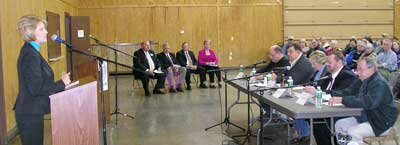 Photo by Sandra Stone
 Photo by Sandra Stone